



"Amazing collection of audio plugins and sample packs. Thanks GoAudio!"

Emi liano Brain Recordings v2.0 Lucien Dargue Series Max For Live for Ableton and Push AMXD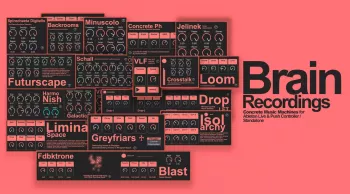 Brain Recordings is a bundle of 15 Max for Live devices for Ableton Push Controller and Push 3 Standalone, built for the practice of musique concrète, microsound, lowercase, and dissipative synthesis.
Each machine operates as a self-contained sound ecosystem: feedback networks, chaotic attractors, granular textures, physical models, electromagnetic captures, and spectral interference, all mapped directly to Push’s encoders for immediate, tactile control.
From the glass particle generator of Concrete Ph, a direct reference to Iannis Xenakis’s 1958 piece, to the Van der Pol oscillator network of Isolarchy, these instruments are designed to evolve, drift, and never repeat exactly. They are not synthesizers in a conventional sense. They are processes.
Compatibility:
Ableton Live 12 — fully tested
Ableton Live 11 — most modules work
Drop and Isolarchy require Live 12
Push 2/3 Controller
Push 3 Standalone
Design note ~ Reverb & Space
Many modules in Brain Recordings have no native reverb. This is a deliberate architectural choice, not an omission.
The priority was keeping each device as lightweight as possible — especially for Push 3 Standalone, where CPU headroom matters and where Ableton’s own built-in reverb suite is already exceptional. On Standalone, Push ships with a comprehensive set of high-quality reverb and space processors available as insert effects on any channel. Use them.
Inside Ableton Live, the options multiply further: convolution reverbs, algorithmic spaces, granular diffusion, chorus, ensemble, and modulation effects can all be stacked after any device in the chain. The modules are designed as sound sources and processes — not closed systems.
That said, several modules do include internal spatial processing where it is architecturally inseparable from the synthesis: Spirochaeta Digitalis uses a five-buffer recursive feedback reverb as part of its core organism; Schall and Minuscolo have built-in delay feedback networks; Backrooms and Futurescape include algorithmic reverb as structural components of their sound architecture; HarmoNish uses the Airwindows Galactic reverb port.
For modules without native reverb, the internal drift and modulation structures already provide continuous slow movement: LFO-driven pitch instability, stochastic envelope variation, chaotic attractor displacement, per-channel asymmetric detuning. These are not static sources waiting for external reverb — they are already in motion. Space, when needed, is yours to add.
Mixing & Coexistence
Designed to coexist.
Every module in Brain Recordings has been fine-tuned in terms of companding, output level, and stereo panorama to sit naturally alongside the others. This is the same approach applied across the entire Lucien Dargue Series — a consistent internal gain structure so that devices from different modules and different sessions can be combined without level conflicts or spectral collisions.
Those already familiar with the timbral character of the series will find Brain Recordings consistent with that same standard. The modules occupy different spectral registers, drift at different rates, and operate in different dynamic envelopes — they are built to layer.
In practice: loading all 15 devices into a single Live session and adjusting only the channel volumes is enough to build complex, evolving compositions. The numerosity itself becomes a compositional strategy — multiple autonomous processes running simultaneously, each contributing its own slow evolution to a shared field. No additional equalisation or gain staging is required to achieve a balanced result.
Homepage:-https://emilianopennisi.gumroad.com/l/zzqmt
Fill your request here and our team will try to post this material on the site

"Amazing collection of audio plugins and sample packs. Thanks GoAudio!"

"One of the best websites for music producers. Keep up the good work!"

"Best audio website ever!"

"Thanks GoAudio!"

"Keep rocking!"
