



Really loving GoAudio.net! The audio quality is great, and the overall experience is smooth and enjoyable. Keep up the amazing…
Fill your request here and our team will try to post this material on the site

Big Man Labs Bigulator v1.0.3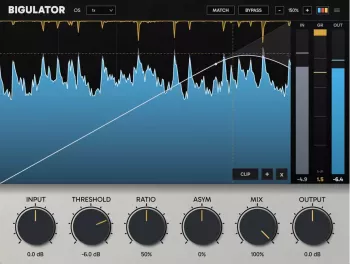 BIGULATOR | A Circuit Model of a Rare Analog Mastering Clipper. Bigulator, a circuit model of an analog mastering clipper, showing the scrolling gain reduction display, transfer curve and control panel
A carefully executed model of an obscure analog mastering clipper that gets loud without ever sounding like it is working. The unusual circuit is the reason: a VCA in series with your audio, its control port driven at audio rate by a peak-skimming rectifier. No envelope. No attack. No release. Bigulator is that circuit, derived from the schematic and fitted to measurements of the real unit, then given what the box never could: multiband operation, oversampling and a multi-voice digital output clipper.
Analog mastering clipper features
What Bigulator does when it is sitting on your master bus.
Exacting Analog Emulation
Through a combination of circuit emulation and numerous measurements, Bigulator captures the analog heart and soul of this unique mastering clipper, nearly indistinguishable apart from the most extreme settings.
Zero Attack, Zero Release
The rectifier drives the VCA control port at audio rate with nothing in between. Gain reduction at any instant is a function of the waveform at that instant. Somewhere between a clipper, a limiter and a saturator, Bigulator is its own flavor of analog level control.
Symmetrical To Totally Out Of Whack
ASYM is that imbalance on a knob. The two halves of the peak skimmer have separate bias trims, so one side starts skimming a fraction before the other. Modeled exactly as the hardware has it, then expanded into places the hardware cannot go. Perfectly symmetrical, to totally out of whack.
Where It Bites Changes How It Bites
Threshold and ratio are separate controls, but they are not independent. Where the threshold sits changes the shape of the transfer function itself, so the same ratio at two different thresholds is not the same processor. Ratio at 100 with the threshold at 0 and ratio at 100 with the threshold at -10 are two different curves, exactly as they are on the analog unit.
One, two or three bands
Run the circuit across the whole mix, or split and run an independent instance per band. Bands keep their identity as you add more, the two crossovers range freely and may overlap, and each band’s gain reduction draws in its own colour so you can see which one is doing the work.
Minimum and linear phase crossovers
Minimum Phase during multiband operation keeps latency low. Linear Phase and Linear Phase Deep split the bands with no phase rotation at all, for mixing and mastering work where you do not want the multiband processing phase artifacts. Deep buys steeper separation for more latency, and every setting reports its delay exactly.
Oversampling to 16x
Analog clipping does not alias. Digital clipping does, and no amount of accuracy in the model fixes it. Run 1x when latency matters or take the nonlinearity up to 2x, 4x, 8x or 16x to push the aliasing products down where the hardware never had any.
Phase-matched parallel blend
MIX blends the processed signal against a dry path tapped before the input trim, so driving harder does not change the dry level. In multiband the dry side carries the same phase rotation the crossover tree applies, so the blend stays comb-free through the crossovers instead of scooping at the corners.
Sum clipper, four voicings
A multi voice digital clipper after the analog model. Tight, Punch, Smooth and Smoother each handle the clip differently. Its ceiling draws a dashed rule across the display, and the output trim runs after it, so level and clip depth stay independent.
See it happening
Input, output and every band’s gain reduction scroll past in real time, GPU accelerated so it stays smooth on a high refresh display without eating your CPU.
Homepage:-https://www.bigman-labs.com/products/bigulator/
Fill your request here and our team will try to post this material on the site

Really loving GoAudio.net! The audio quality is great, and the overall experience is smooth and enjoyable. Keep up the amazing…

The sound quality is amazing. I absolutely love it!

Many, many thanks! That was super quick! I requested this file just yesterday and received it today. Wow, amazing service!…

Thanks for this amazing file! One of the best websites ever.

Thank you so much for sharing this file! This is truly one of the best websites I’ve ever come across.…