



And how to get last three months libraries likes keep.forest one and fracture sounds trails 2 and compendium as iam…

Fors Opal v1.4 Ableton Max for Live AMXD ALP+Artist packs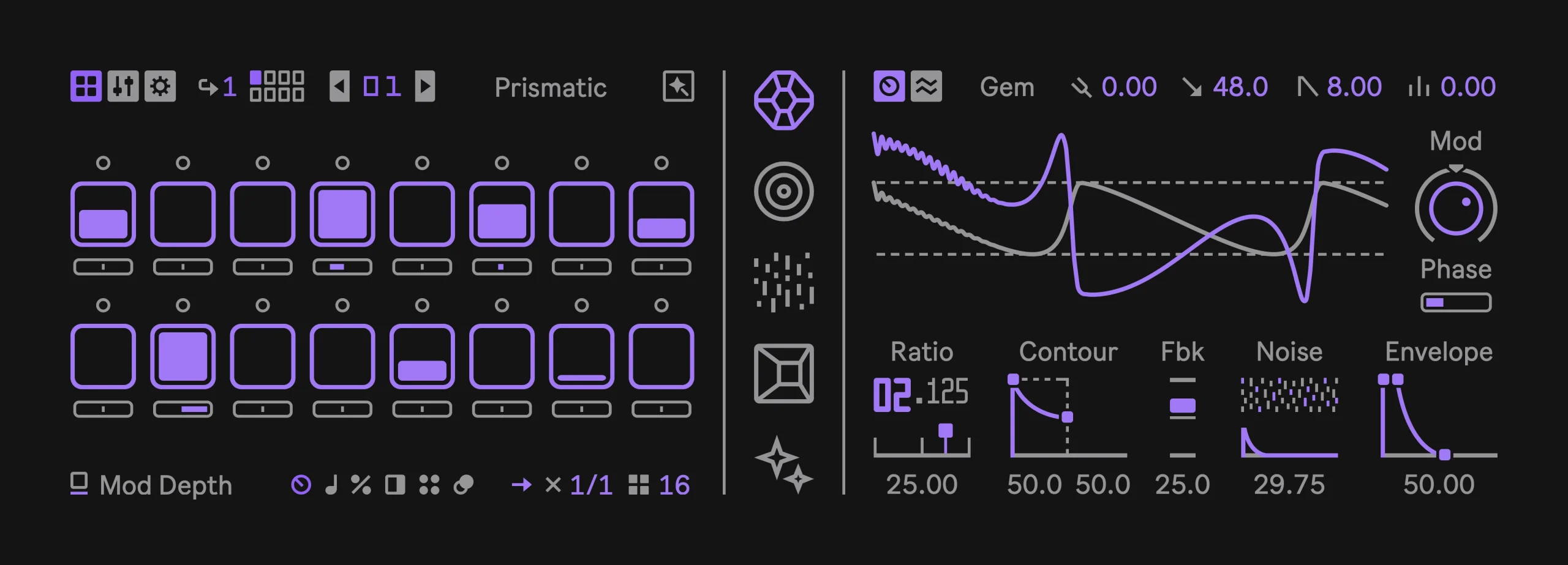
Rhythm machine & drum synthesizer harnessing the hardware groovebox experience with deep modulation sequencing and unique synthesis.
Rhythm machine
Opal is an instrument made for intricate pattern creation. With parameter locks, probability, conditionals, ratcheting, independent track length, time division and traversal, it’s a breeze to program exciting patterns.
Drum synthesizer
Opal comes with four distinct, highly malleable, synthesizers and two sequenceable effects. While the synths are tailored for creating drum sounds, it’s up to you to choose where, or if, the line between percussion and melody is drawn.
Each component of Opal can also be used as a standalone instrument, including the sequencer which can transform your favorite devices and plug-ins into a groovebox-style instrument.
Meet the engines
Gem is an FM synthesizer capable of a wide variety of sounds, from deep and heavy bassdrums to glistening lead melodies. At its core, Gem consists of 2-Operator sinewave-based phase modulation that has been fine-tuned to sound rich and punchy.
With bipolar modulation and feedback, it’s possible make a vast range of different waveshapes- including common analog shapes such as square, triangle or sawtooth.
It’s a highly malleable form of synthesis that has been boiled down to its essentials, with an emphasis on the sheer quality of execution.
Mass is a modal synthesizer, which is a type of physical modeling synthesis that employs a bank of bandpass filter to generate its sound. Typically, physical modeling is used to mimic real-world sounds, but with Mass the essence of the synthesis method is used to make all sorts of wildly synthetic sounds, often with an otherworldly quality due to its physically-inspired origins.
The sounds possible with Mass ranges from semi-realistic percussion, bells, textures, noises, strange phase-y melodic sounds to clean and precise timbres reminiscent of additive synthesis.
Dust is a noise generator that is based around the concept of Pulsar synthesis, which is a method adjacent to Granular synthesis. The sound is composed of very short particles of sounds that creates a texture when played fast and/or dense.
Dust combines concepts from all kinds of different types of synthesis methods to create anything from pure white noise to perfectly soft spectral washes. By layering multiple oscillators Dust can also generate classic electronic metal sounds which is very useful for making hi-hats and cymbals.
Slate is a sample playback engine equipped with a granular mode that can wildly transform any sample. At its core is a high quality sample playback engine with edge smoothing (click-less playback and looping), single cycle waveform support and a flexible loop mode.
The granular mode let’s you go deeper in sound design by playing back small particles in a pattern that essentially reconstructs the original sound, but with the possibility to dramatically change the speed and pitch independently
The FX track hosts two different effect engines: Void and Flux. Void is a reverb with an emphasis on good transient response for many different kinds of input sounds. With in-depth EQ:ing of the input and reverb signal, it’s possible to greatly shape the overall tone of the effect.
Flux is an automatic sampler that continuously records the output of all the other tracks and divides it into 16 slices that can be played back by the FX track. Think of it like an always-recording tape loop that you can use to repeat or transform sections of your pattern by playing different snippets as single shot samples.
Each engine has a dedicated modulation page with four different modulation sources that can be routed to any parameter via a modulation matrix.
The different sources are Vel – velocity received from the sequencer steps (or a MIDI note), A dedicated LFO and Envelope per track, and a random value (Rand) that is received on each trigger of a step or MIDI note.
Sequencer modulation
Parameter lock
Parameter locks allow you to set a unique value for any synthesizer parameter on each step in the sequencer. This is a powerful method which essentially allows you to have a unique sound on every step.
Opal-Ctl
External sequencing
Opal-Ctl is the MIDI version of Opal that lets you take control of your favorite devices and external plug-ins in Ableton Live with Opal’s extensive sequencing capabilities and modulation. With 10 customizable controls you can transform anything into your very own groovebox.
Each to their own
The different synth engines in Opal also comes as separate Max for Live devices which you can sequence, automate and route however you want.
… And if you ever run out of inspiration, Opal can generate random sounds, variations, sequences and even completely new and unique patterns. Let the machine surprise you.
Artist packs
We asked some of the artists that we love to create sounds using Opal. Take a listen and let these packs inspire you to explore something new. If you already own Opal you can download and import each artist’s Opal bank and take a closer look.
Take a closer look
Opal feels right at home in the Ableton device rack, but equally so in its own floating window with up to 400% UI scaling.
To sum it up
Step-sequencer with:
Parameter locks
Probability & Step logic
Ratcheting
Microtiming
Per-track length & division
Per-track swing
Per-track direction
External sequencing
With up to 128 steps per track
Five tracks with:
Gem FM Synthesizer
Mass Modal Synthesizer
Dust Pulsar Noise Synthesizer
Slate Granular Sample Player
Void Reverb & Flux Sampler
With modulation
MPE pitch-bend support
& individual outputs
+ Randomizer
Requirements
Opal is a collection of Max for Live devices and requires Ableton Live Suite (or standard with the Max for Live add-on) to use. It is not compatible with any other DAW.
Minimum:
Ableton Live Suite 10.1+
macOS 10.11.6, Intel i5, 4GB RAM
Windows 7, Intel i5, 4GB RAM
Recommended:
Ableton Live Suite 11+
macOS 12+, M1, 8GB RAM
Windows 10, Intel i7, 8GB RAM
—- Opal Changelog —-
Features:
– Scale quantizer added on config page
quantizes notes to nearest neighbor in the scale
sets the scale of the random pattern generator
Improvements:
– New & improved de-clicking algorithm
retains transient, better click supression
– Drop sample area added to the rack view of Opal pop-out version
– Click sample name in Slate to load a sample file
Bugfixes:
– Switching and/or randomizing pattern quickly could result in a crash
Fill your request here and our team will try to post this material on the site

And how to get last three months libraries likes keep.forest one and fracture sounds trails 2 and compendium as iam…
Please send this link to me

"Amazing collection of audio plugins and sample packs. Thanks GoAudio!"

"One of the best websites for music producers. Keep up the good work!"

"Best audio website ever!"